Ultrapure water production
From node-by-node plant documentation to a terminal-UF investment case
| Context | Industrial team project |
|---|---|
| Period | Completed January 2025 |
| Role | Team documentation; personal ownership of selected nodes, flowsheets, calculations and vendor comparison |
| Domain | Process utilities · ultrapure water treatment |
| Methods | Node-by-node process analysis · Mass and energy balances · Configuration comparison · Equipment vendor comparison |
| Stack | Python · Process flowsheets · Technical documentation |
| Status | Study completed; findings carried into the following qualification work |
The engineering question
The initial task was not to optimise a single item of equipment. It was to understand a complete ultrapure-water station well enough to compare its current architecture with a future configuration including terminal ultrafiltration.
That required following both production chains from inlet treatment to storage and distribution, identifying what each node removes or controls, and then placing energy, water quality, operability and qualification requirements in the same picture. A configuration can be attractive in a balance sheet and still be difficult to operate, maintain or qualify. Conversely, an apparently redundant barrier may address a different failure mode from the equipment upstream.
Why the obvious comparison fails
Two things made this harder than reading a datasheet.
The first was that the station’s own flowsheet was withheld until late in the project for confidentiality reasons. The documentation had to be reconstructed from the installation itself: following lines, reading equipment plates, asking what each node was there to do. Only then could a comparison begin. I was also learning the domain from zero, with a senior engineer of some decades’ experience as supervisor. Neither of those is an obstacle worth complaining about, but both mean the analysis started from the plant rather than from a drawing of it.
The second is more interesting, because it is the reason the decision is not the formality it looks like. On the two variables that are easy to see (energy consumption and alignment with the intended regulatory approach), terminal ultrafiltration wins clearly enough that the choice appears settled before any study is done. The variables that actually decide it do not appear in a balance:
- operators know the existing equipment, and that familiarity is what makes maintenance cheap and fast today;
- new equipment brings a qualification burden that has to be paid before it produces anything;
- and an organisation that has run a configuration for years has real inertia against replacing it, which is not irrational: it is the accumulated value of knowing how the current one fails.
A configuration can therefore win on paper and lose on the floor. The difficult part of this study was not computing the comparison. It was working out which terms belonged in it.
How the work was divided
The station documentation was produced jointly by two students. We divided the plant by nodes so that each person could investigate a smaller part in depth before the complete process was assembled.
My personal scope included:
- the deionisation stage;
- the storage tank;
- the multiple-effect distillation unit;
- hand-built process flowsheets for the existing installation and the proposed terminal-UF configuration;
- mass- and energy-balance calculations and their comparison in Python;
- a comparison of equipment vendors;
- engineering questions and investment options derived from the combined process view.
My teammate covered other nodes, including reverse osmosis and activated-carbon filtration, and led the qualification and regulatory sections. We then compiled the contributions into a report of more than 40 pages.
From documentation to configuration choices
The node-by-node documentation was the foundation rather than the final deliverable. Once the full station was legible, I redrew the process as two flowsheets: the existing route and the proposed route with terminal UF. This made it possible to compare not only equipment blocks but also interfaces, bypasses, utilities and fallback modes.
Several practical questions emerged from that comparison:
- Should the MED be retained as a backup instead of being treated as obsolete?
- Could a dual-production arrangement feed the MED from the first-RO stream, bypassing the second RO when that operating mode is appropriate?
- What does each configuration imply for energy consumption, equipment wear, maintenance and qualification?
- Why add terminal UF downstream of a double-RO train when a simple comparison of nominal pore sizes can make the order look counter-intuitive?
The last question captures the main lesson of the project. A treatment train cannot be assessed by ranking barriers on one physical dimension. Each node has a removal duty, a control role and an operational context. Understanding the sequence requires process engineering, water quality, equipment behaviour and regulatory compliance to be considered together.
Quantitative work
I calculated mass and energy balances for the configurations and wrote Python scripts to make the comparison reproducible. The objective was to show where the energy demand moved when the architecture changed and which assumptions were driving the result, rather than to present a single unexplained saving.
I also compared equipment vendors against the needs identified in the process study. That work connected the flowsheet-level conclusion to concrete, targeted investment suggestions: what equipment would be required, which claims needed verification and which questions should be taken back to a supplier before purchase.
Outcome
The final techno-economic and engineering comparison supported investment in terminal ultrafiltration. Energy consumption and alignment with the intended regulatory approach were important parts of the favourable verdict.
The report did not reduce the decision to “UF versus MED”. It preserved fallback and hybrid options, including keeping the MED as a backup and examining alternative feed paths. This made the recommendation more robust to the industrial realities that a simplified flowsheet leaves out.
According to the project sponsor, the document was used during the following year’s qualification pipeline. I did not personally execute or audit that later so I present this as reported downstream use rather than as an implementation claim.
How the conclusions were checked
I did not validate this work myself, and it would be misleading to present it as though I had. The checking was done by the senior engineer supervising the project, who was both the recipient of the report and its reviewer: he flagged errors, issued corrections and validated the sections as they were rewritten. The document went through several rounds on that basis. Whatever robustness it has comes from that review, not from a verification I performed on my own work.
The clearest illustration is a proposal of mine that did not survive it. I suggested doubling the feed and running the two reverse-osmosis units in parallel rather than in series, so that the water takes a single pass instead of two. I checked the side I knew how to check: with the three-effect still downstream, the specification was still met on one RO pass, because the effects were strong enough to absorb the difference in ionic load. On quality grounds the proposal held.
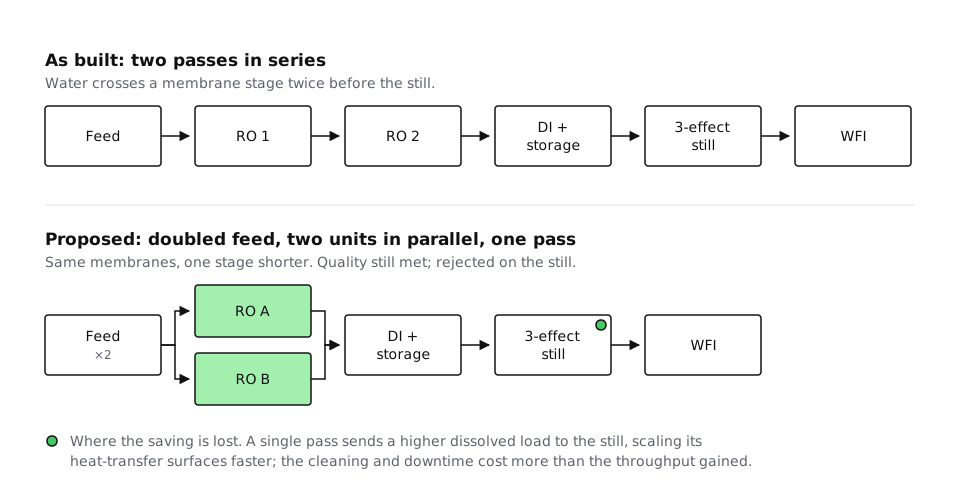
The proposal and the reason it failed. On the membrane side the shorter route holds; the cost lands downstream, on a unit the arrangement never touches. Schematic: topology only, with no flows or duties shown.
The objection was one I had not thought of. A higher dissolved load arriving at the still scales its heat-transfer surfaces faster, and the cleaning and downtime that follows costs more than the throughput the parallel arrangement buys. The idea was rejected on process grounds, which is the right way for an idea to die, and the reason I remember it better than the parts that were accepted.
The one validation still outstanding is the one that matters most. The equipment is at the time of writing still under specification, so the report’s assumptions have not yet met an installed plant. Whether they hold is a question only the commissioned station can answer.
Limitations and what I would revisit
The part of the recommendation I would contest today is the verdict on the still. Keeping the multiple-effect unit as a standby against a membrane failure means a large, capital-intensive item sitting idle waiting for the fault it insures against. That is a defensible answer to a reliability question, but it was never posed as a utilisation question, and those have different answers. If the still is to be retained, the better question is whether it can carry a duty elsewhere on the site rather than wait. And if it cannot, whether standby capacity is really what that capital is for.
The study also has no post-installation evidence behind it, for the reason given above, and its cost side cannot be published. A reader should treat the conclusion as a well-reviewed engineering argument, not as a measured outcome.
The next step I would take is the one the study skipped: reopen the standby decision as an asset-utilisation problem. What duty could the still carry, what does the site lose if it is redeployed and a membrane does fail, and is that exposure worth less than the unit is worth doing something else.
What this project taught me
The strongest part of the work was not an isolated calculation. It was moving from detailed equipment understanding to a system-level decision without losing the practical constraints between them. The balances made the energy case visible; the vendor comparison made the investment actionable; and the configuration questions tested whether the preferred answer could survive maintenance, qualification and real operation.
Questions about this work? [email protected]